
Understanding WRAS approval, MID approval and water meter accuracy classes can help ensure the correct meter is selected for your application, installation position and billing requirements.
What is WRAS Approval?
Demonstrating compliance with UK water fitting requirements.
Any water fitting installed to carry or receive water from the public mains water supply in the UK must comply with the Water Supply (Water Fittings) Regulations or the equivalent Scottish Byelaws.
These requirements are designed to ensure that water fittings do not cause waste, misuse, undue consumption or contamination of the water supply, and that products are manufactured to an appropriate quality and standard.
WRAS Approval provides a recognised way of demonstrating compliance and is widely accepted by UK water suppliers.
WRAS Product Approval
Complete products such as valves, boilers, showers and other water fittings undergo mechanical and water-quality testing. Approval demonstrates compliance with the relevant requirements, subject to any installation conditions attached to the approval.
WRAS Material Approval
Non-metallic materials and components, such as rubber sheet materials and O-rings, are tested for their effect on water quality. Approval demonstrates that the material or component does not itself adversely affect the water supply.
WRAS approval can apply to both cold and hot water meters, depending on the individual product approval.
What is MID Approval?
Approval for measuring instruments used in regulated measurement and billing applications.
MID stands for the Measuring Instruments Directive. It establishes common requirements for a range of measuring instruments used in domestic, commercial and light-industrial applications.
MID approval provides a common conformity framework for a number of measuring instrument types, including:
- Water meters
- Gas meters and volume conversion devices
- Active electrical energy meters
- Heat meters
- Measuring systems for liquids other than water
- Automatic weighing instruments
- Taximeters
- Material measures
- Dimensioning systems
- Exhaust gas analysers
MID-approved meters must satisfy the appropriate conformity assessment procedures and carry the relevant conformity markings.
For applications where a meter is being used for billing or other regulated measurement purposes, it is important to ensure that the selected product carries the appropriate approval for its intended use.
How Do I Know if My Meter is MID Approved?
Look for the conformity and metrology markings on the meter or product documentation.
MID-approved meters will normally carry an approval marking similar to the example shown below.
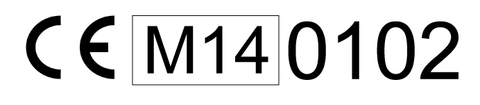
The marking typically includes the relevant conformity mark, the M metrology mark, the year of manufacture and the identification number of the notified or approved body responsible for conformity assessment.
For water meters, MI-001 is the applicable measuring-instrument category.
What Does the Accuracy Class of a Water Meter Mean?
Understanding the R ratio can help you compare meter performance at lower flow rates.
Water meter accuracy is commonly expressed using an R value, such as R80, R160 or R800.
In general, a higher R value indicates that the meter can maintain its specified accuracy across a wider measurement range and measure lower flow rates more effectively. For example, an R800 meter offers a substantially wider measuring range than an R160 meter.
Installation Position Matters
The installation position of a meter can affect its declared accuracy. For example, some multi-jet meters achieve a higher R rating when installed horizontally with the dial facing upwards than when installed vertically.
The product data sheet should always be checked to confirm the accuracy class for the intended installation position.
When comparing meters, make sure that the quoted R value applies to the way the meter will actually be installed. A meter advertised with a high horizontal accuracy rating may have a lower rating when installed vertically.
Need Help Selecting a Water Meter?
Selecting the correct water meter depends on more than pipe size alone. Application temperature, expected flow rate, installation orientation, approval requirements and remote-reading options can all affect which meter is most suitable.
If you are unsure which meter or approval is required, contact Stockshed Metering and we can help you identify the most appropriate product for your application.